
|
|||||||||
|
|
|||||||||
|
|||||||||
|
|
|||||||||
|
Executive Summary
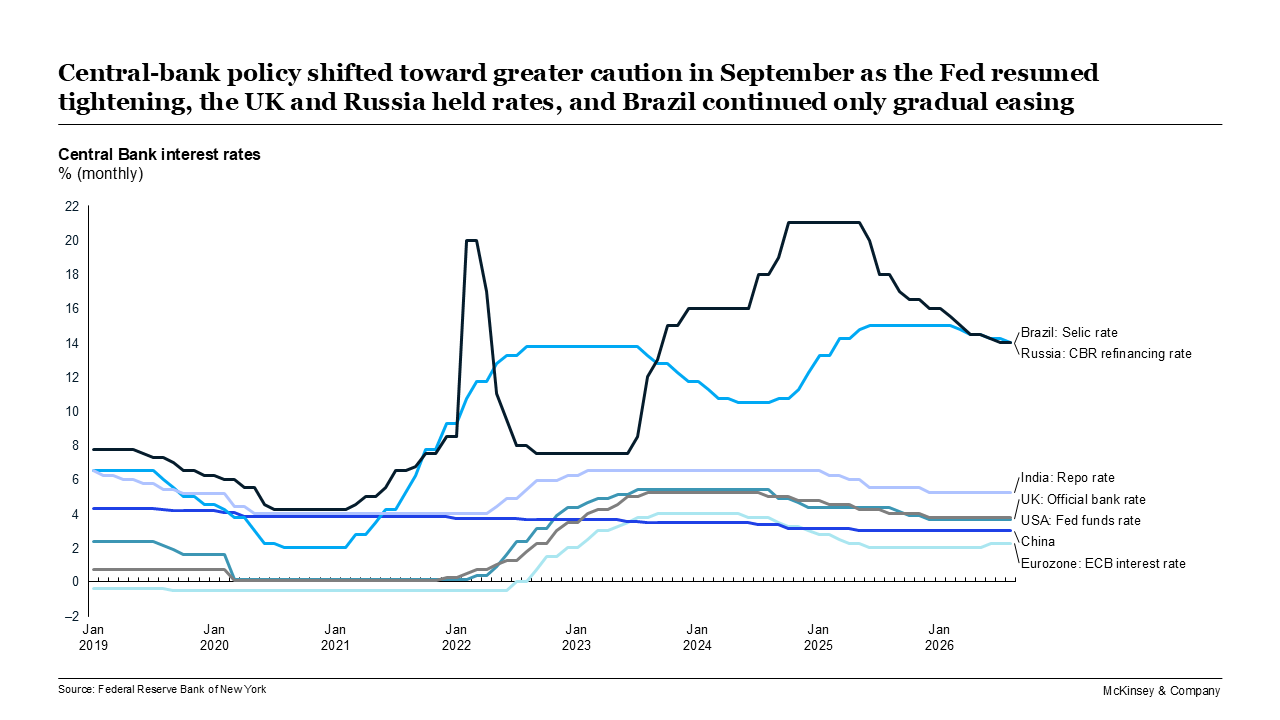
Central banks move to tighten interest rate policies as energy price spikes fuel inflation; growth look sparse in some economies, but activity indicators see manufacturing and services expanding.
Balancing inflation, growth aspirations, and debt levels amid the current challenging global economic environment is providing plenty of food for thought for both central bankers and finance ministers mulling their strategies. Yet, whatever politicians might prefer in the current climate, the policy consensus among central bankers looks to have shifted toward greater caution in September as the Fed resumed tightening, the UK and Russia held rates, and Brazil continued only gradual easing. Brazil was the only surveyed economy to cut rates in September: in a unanimous decision on September 16, Banco Central do Brazil’s Monetary Policy Committee decided to cut the Selic rate by 25 basis points, bringing it to 13.75.%. In the United States, the Federal Open Market Committee (FOMC) voted 12–0 on September 16 to raise the target range for the federal funds rate by 25 basis points to 3.75–4.00%, its first hike since 2023. It cited elevated inflation and a timelier return to the 2% goal. The 30-year bond yield reached 5.5% the following week—the highest since June 2004. Across the Atlantic, the European Central Bank increased its deposit facility rate to 2.5% in September from 2.25% in August, as policymakers responded to renewed inflationary pressures despite subdued demand. In the United Kingdom, the Bank of England held the Bank Rate at 3.75% in September, again by 6–3, with three Monetary Policy Committee (MPC) members favoring a quarter-point hike. It judged inflation risks to have shifted further to the upside; BoE staff now expect inflation to reach slightly above 4% in early 2027. Fiscal conditions in the UK remain constrained: August borrowing of £18.3 billion overshot the Office of Budget Responsibility’s forecast by £3.5 billion and was £2.9 billion higher than a year earlier, as spending growth outpaced receipts. In the short term, attention turns to Chancellor John Healey’s first Budget on October 28, also the Burnham government’s first. The government has committed to the inherited fiscal rules and to not raising the main rates of income tax, employee National Insurance, or VAT. At the same time, borrowing is running above forecast and the government is pursuing an agenda of devolution and cost-of-living relief. Inflation is rising across advanced economies, driven primarily by higher energy prices, and reached 3.8% in the eurozone in September. Notably, Oil and European gas prices rose further in September as geopolitical disruption intensified concerns about global energy supplies and renewed inflationary pressures. Brent crude averaged $114 a barrel in September, $23 higher than in August, as the Strait of Hormuz standoff continued to constrain Middle East exports. Prices peaked at almost $131 a barrel on September 15 before easing to around $114 by month-end. In general, as the Middle East conflict continues, oil-market volatility remains elevated. That said, inflation expectations increased only moderately in September. The knock-on effect of higher fuel prices is affecting consumers, with US air travelers reportedly facing fares at a ten-year high over the Thanksgiving break. Headline consumer price index (CPI) inflation In the United States was up 3.4% year over year in August, after rising 3.4% in July. Core inflation rose 2.4% (annualized). In August, median inflation expectations dipped by 0.1 percentage points to 3.2% at the three-year-ahead horizon and were unchanged for the one- and five-year-ahead horizons at 3.6% and 3.0%, respectively. Inflationary pressures also intensified in the eurozone, with headline inflation accelerating to 3.8% in September from 3.2% in August, a third consecutive monthly increase and the highest reading in a year. Producer price inflation climbed to 8.2% in August from 5.8%, reflecting rising energy and commodity costs. In the United Kingdom, inflation reaccelerated. CPI rose to 3.1% in August, a five-month high and a second straight monthly increase. Transport led the rise, with motor fuel prices up 23% year on year and goods inflation at 2.7%. With core CPI unchanged at 2.6% and services steady at 3.4%, the pickup so far looks concentrated in energy rather than being broad-based. Inflation is also trending upward across developing economies, but at a slower pace than the advanced economies. In India, retail inflation (CPI) stood at 4.82% in August, with food inflation (CFPI) firming to 5.95% from 5.52% in July as weak monsoon rains lifted staple prices. In Russia, consumer price inflation accelerated further in August, with prices up by 6.3% annually amid continued supply chain disruptions and increasing fuel prices. Rapid growth in government expenditure also contributed to supply-demand imbalance and fueled inflation. In Mexico, annual inflation increased to 3.3% from 3.1% in July but remained within the Bank of Mexico’s target range. Brazil bucked the trend with inflation down in August, touching 4.22% (4.44% in July) and below the central bank’s upper target limit of 4.50%. |
|||||||||
|
|
|||||||||
|
|||||||||
|
|
|||||||||
|
Growth is looking more fragile in some economies. In the United Kingdom, monthly real GDP rose 0.4% in July, beating forecasts of no growth, with the three-month measure also up 0.4%—driven by services (+0.6%); production and construction each fell 0.5%. However, business surveys point to softer momentum in September. In China, growth remains below year-ago levels, with third-quarter GDP growth estimated at 4.4%, down from 4.8% a year earlier. Meanwhile, a second GDP reading confirms that the Russian economy grew by 1.3% year on year in the second quarter of 2026. By contrast, at its August 5 review the Reserve Bank of India raised its 2026–27 real GDP growth projection modestly to 6.7% (from 6.6% in June), reflecting the country’s economic resilience in the face of global uncertainties.
Global consumer confidence remained broadly unchanged, despite a return to optimism in the United Kingdom. In Brazil, consumer confidence stayed below the neutral 100 mark, with FGV’s seasonally adjusted August reading moving down to 84.7. Meanwhile, business confidence declined to 91.1; construction confidence deteriorated to 92.1. Consumers in the United Kingdom, United States, and Russia spent around 3–6% more than a year ago, while consumers in other major economies tightened their belts. August’s retail and food services sales in the United States (adjusted for seasonal variation and holiday and trading-day differences) reached $773.9 billion, up 1.2% from July’s revised $764.5 billion. The Consumer Confidence Index (Conference Board) edged down to 89.4 in August from a downwardly revised 90.2 in July. In China, household consumption remains subdued. Retail sales growth slowed to 0.4% as the impact of earlier subsidies faded and households continued prioritizing savings over spending. Consumer confidence continues to be depressed at 90, while unemployment rose to 5.3%, with rising youth joblessness adding further pressure. Both manufacturing and services accelerated, with services continuing to expand faster. Manufacturing growth broadened in September, led by India; Brazil moved deeper into contraction and Russia approached stabilization. The US industrial production index remained steady at 103.1 in August, while the S&P Global US Manufacturing PMI (purchasing managers index) jumped to 57.0 in September 2026 from 53.9 in August, the strongest improvement in manufacturing business conditions since May 2022. Industrial activity in the eurozone showed signs of improvement, with the manufacturing PMI rising to 52.9 in September from 52.7—its highest level in 12 months and the third consecutive monthly increase. However, stronger business sentiment has yet to translate into higher output, with industrial production edging down to 98.3 in July from 98.4, and remaining below year-ago levels. Elevated energy costs continue to constrain energy-intensive industries, limiting the strength of the manufacturing recovery despite improving survey indicators. In India, the HSBC India Composite PMI rose to a three-month high of 55.9 in September from 54.3 in August, though the quarterly average was the weakest since early 2022. Manufacturing climbed to 55.1 from 52.8, its strongest in seven months, as new orders grew at their fastest pace in seven months. Services activity expanded across most major economies in September, led by the United States and India. The US services PMI climbed once again, to 58.7 in September from August’s 56.5. India’s services PMI rose to 55.2 from 54.1, the best reading since June. |
|||||||||
|
|
|||||||||
|
|||||||||
|
|
|||||||||
|
There was little change in US total nonfarm payroll employment, which increased by 29,000 in September, while the unemployment rate was unchanged at 4.1%. Additionally, August’s initial job gain estimate (+162,000) was revised down to a 133,000 increase instead.
Global equity performance weakened and became less evenly distributed in September as rising oil prices and bond yields offset support from strong earnings expectations. September action on the US markets saw the S&P 500 down 0.4%, bringing the one-year return to approximately 14.4%; the Dow Jones fell 4.1% over the month and posted approximately an 11.5% one-year return. September’s CBOE Volatility Index increased to 16.3 (after falling to 14.9 in August). Meanwhile, the price of government borrowing increased in September as bond yields rose with renewed inflation and fiscal concerns boosting term premiums. Commodity markets diverged in September: energy and agricultural prices rose amid supply disruptions, industrial metals remained supported by infrastructure demand, while precious metals retreated. Gold prices declined in September in the context of rising bond yields and a stronger US dollar. Copper prices remained near record highs in September, supported by constrained supply and infrastructure demand, while aluminum strengthened and nickel continued to lag. Global food prices rose further in September, with increases broadening from vegetable oils to cereals and sugar. Turning to global trade, export growth through July remained uneven across major economies, with the strongest gains in Mexico and China. Import demand, meanwhile, diverged sharply across major economies, with year-to-date growth led by China and Mexico. In August global container throughput was flat while port trade continued to ease from recent peaks. Global supply-chain pressures rose again in September, staying above normal but far below pandemic-era extremes. Container freight rates from China rose on US routes and fell on European routes in September, while US outbound freight to China edged down after a summer rise, remaining far below 2025 peaks. In the United States, August exports reached $315.2 billion, up $4.5 billion from July. Imports hit $420.8 billion, $17.2 billion more than in July. The monthly deficit climbed by 13.7% to $105.6 billion. External demand remains a key growth engine for China. Its trade surplus widened to $112.8 billion in August, supported by strong high-tech-related exports, which continue to offset weakness in domestic consumption. However, renminbi appreciation could increasingly pressure exporters’ margins and competitiveness, particularly in more price-sensitive industries. In India, exports rose more than 26% year on year to $43.81 billion in August 2026 from $34.74 billion and outpacing imports, which grew to $70.67 billion from $61.96 billion, narrowing the trade deficit. Brazil’s trade balance recorded a surplus of $7.9 billion in August, up from $6.5 billion in July. Mexico saw external accounts weaken in July, with the trade balance shifting to a $0.8 billion deficit from a $4.1 billion surplus in June. Exports increased 12.2% month on month to $81.4 billion from $72.5 billion, supported by stronger manufacturing shipments, while imports rose 20.2% to $82.3 billion from $68.5 billion. Meanwhile, trade relationships continue to shift around the globe. The White House continued its spat with Canada with President Donald Trump signing five proclamations on September 8 under Section 338 of the Tariff Act of 1930. These banned imports of certain Canadian alcoholic beverages, dairy products, and motorcycles effective September 29 and expanded the scope of existing 50% duties from September 15. The move followed Canada’s imposition of roughly $20 billion in retaliatory tariffs on US exports the same day. The measures apply regardless of USMCA qualification. Meanwhile, India and New Zealand will bring their Free Trade Agreement into force from October 20, giving fresh momentum to bilateral trade, technology, and investment ties. Additionally, India and South American trade bloc MERCOSUR signed the First Additional Protocol to their Preferential Trade Agreement.
* * *
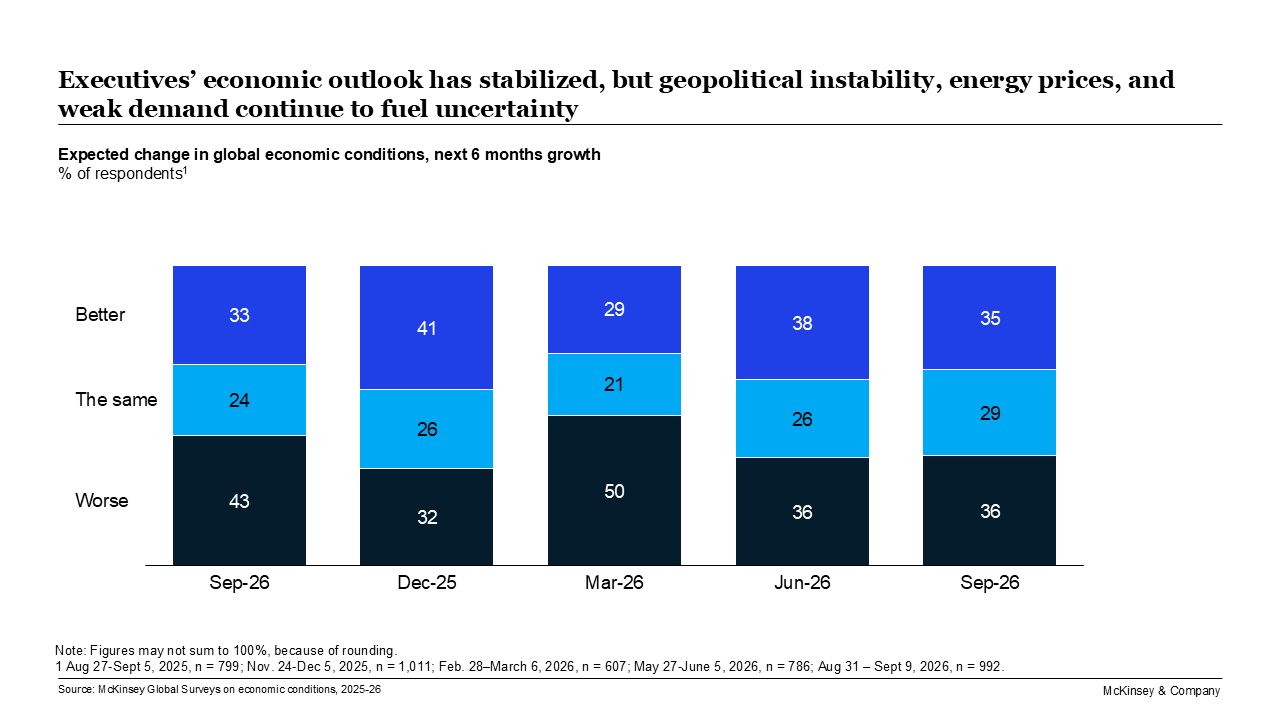
McKinsey’s latest “ Economic conditions outlook” survey finds that, after a spike in pessimism last quarter, executives are less pessimistic but, nevertheless, remain cautious in the context of current global uncertainty. The September 2026 survey sees negative views continue to be more common than positive ones, while expectations for the next six months are mixed. In the field from August 31 to September 9, the survey notes that, for both the wider global economy and executives’ home economies, the proportion of executives reporting worsening conditions in the past six months continues to be larger than those reporting improvements. Meanwhile, expectations for the next six months remain divided. The survey logged executives as nearly as likely to expect global economic conditions to worsen as to improve, with the outlooks for their own countries’ economies similarly split. Overall, executives’ economic views have steadied, but uncertainty remains. Geopolitical instability, energy prices, and weak demand—alongside inflation in Europe and North America—are perceived as the near-term risks. At the same time, respondents continue to prioritize AI investment and view technological shifts more as growth opportunities than immediate economic threats. |
|||||||||
|
|
|||||||||
|
|||||||||
|
|||||||||
|
Regional and Country Summary
Fed raises target rate by 25 basis points; eurozone inflation accelerated to 3.8% in September; energy pushes UK inflation back up, contributing to rise in borrowing costs.
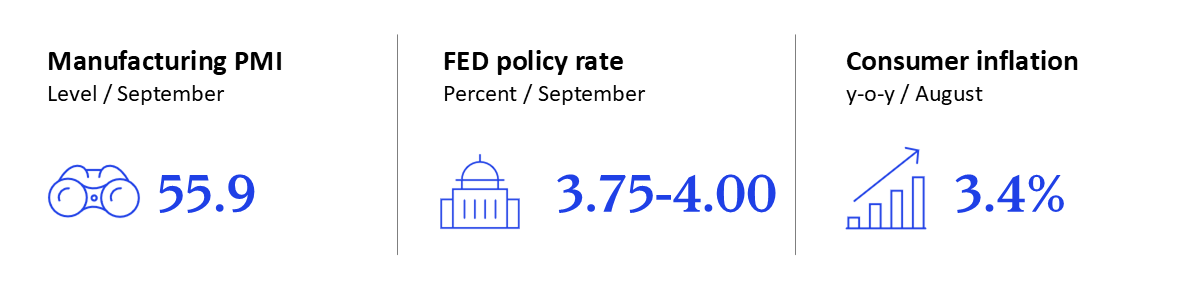
United States Fed votes to raise the target rate by 25 basis points; manufacturing PMI jumped to 57 in September; monthly trade deficit increased by 24.4%. The industrial production index remained steady at 103.1 in August. The S&P Global US Manufacturing PMI (purchasing managers index) jumped to 57.0 in September 2026 from 53.9 in August, the strongest improvement in manufacturing business conditions since May 2022. The services PMI rose to 58.7 in September from 56.5 in the previous month. July exports reached $310.7 billion, down $6.6 billion from June. Imports hit $399.3 billion, $10.8 billion more than in June. The monthly deficit climbed by 24.4% to $88.6 billion. Headline CPI inflation was up 3.4% year over year in August, after rising 3.4% in July. Core inflation rose 2.4% (annualized). In August, median inflation expectations dipped by 0.1 percentage points to 3.2% at the three-year-ahead horizon and were unchanged for the one- and five-year-ahead horizons at 3.6% and 3.0%, respectively. August’s retail and food services sales (adjusted for seasonal variation and holiday and trading-day differences) reached $773.9 billion, up 1.2% from July’s revised $764.5 billion. The Consumer Confidence Index (Conference Board) edged down to 89.4 in August from a downwardly revised 90.2 in July. |
|||||||||
|
|
|||||||||
|
|||||||||
|
|
|||||||||
|
On the housing market, the 30-year fixed-rate mortgage remained at 6.7% in August. Existing home sales decreased by 2.0% in August, while housing residential starts declined to 1,275,000 (below the revised July estimate of 1,309,000)—a 2.6% decrease. Completions in August were down 11.9%, reaching 1,128,000, compared with the revised July estimate of 1,333,000.
Total nonfarm payroll employment changed little, increasing by 29,000 in September, while the unemployment rate was unchanged at 4.1%. Additionally, August’s initial job gain estimate (+162,000) was revised down to a 133,000 increase instead. In September, the S&P 500 was down 0.4%, bringing the one-year return to approximately 14.4%; the Dow Jones fell 4.1% over the month and posted approximately an 11.5% one-year return. September’s CBOE Volatility Index increased to 16.3 (after falling to 14.9 in August). The Federal Open Market Committee (FOMC) voted 12–0 on September 16 to raise the target range for the federal funds rate by 25 basis points to 3.75–4.00%, its first hike since 2023. It cited elevated inflation and a timelier return to the 2% goal. The 30-year bond yield reached 5.5% the following week, its highest since June 2004. Brent crude averaged $114 a barrel in September, $23 higher than in August, as the Strait of Hormuz standoff continued to constrain Middle East exports. Prices peaked at almost $131 a barrel on September 15 before easing to around $114 by month-end. Global oil inventories have fallen by about 400 million barrels so far this year. President Trump signed five proclamations on September 8 under Section 338 of the Tariff Act of 1930, banning imports of certain Canadian alcoholic beverages, dairy products, and motorcycles effective September 29, and expanding the scope of existing 50% duties from September 15. The actions followed Canada’s imposition of roughly $20 billion in retaliatory tariffs on US exports the same day. The measures apply regardless of USMCA qualification. |
|||||||||
|
|
|||||||||
|
|
|||||||||
|
Eurozone
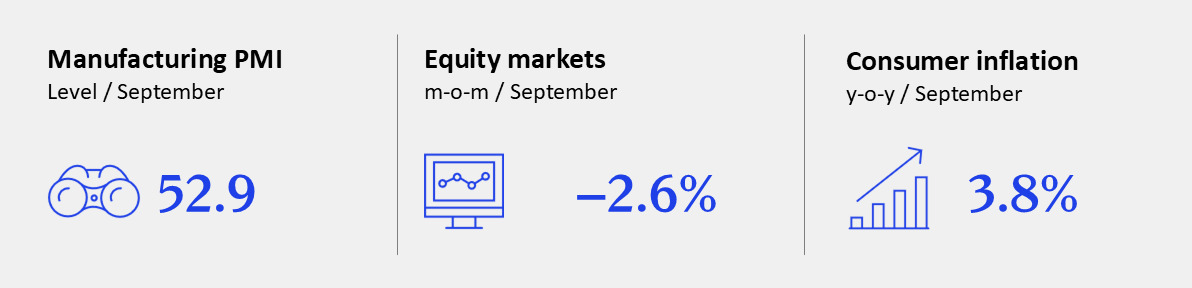
Euro area inflation accelerated to 3.8% in September as rising energy costs pushed producer prices higher, while domestic demand remained subdued; manufacturing activity strengthened, but weak consumption and mounting price pressures complicate central bank’s policy outlook. Inflationary pressures intensified, with headline inflation accelerating to 3.8% in September from 3.2% in August, a third consecutive monthly increase and the highest reading in a year. Producer price inflation climbed to 8.2% in August from 5.8%, reflecting rising energy and commodity costs. Core inflation remained comparatively contained at 2.5%, suggesting that broader price pressures have yet to fully materialize. Nevertheless, the widening divergence between headline and core inflation raises concerns about potential second-round effects as businesses face higher input costs. Industrial activity showed signs of improvement, with the manufacturing purchasing managers’ index (PMI) rising to 52.9 in September from 52.7—its highest level in 12 months and the third consecutive monthly increase. However, stronger business sentiment has yet to translate into higher output, with industrial production edging down to 98.3 in July from 98.4, and remaining below year-ago levels. Elevated energy costs continue to constrain energy-intensive industries, limiting the strength of the manufacturing recovery despite improving survey indicators. Household demand remained subdued. Retail sales volumes were broadly flat, reflecting continued caution among consumers. Household lending growth accelerated to 3.1%, its strongest pace in a year, but stronger credit expansion has yet to translate into meaningful consumption growth. Meanwhile, unemployment remained at 6.4%. Rising energy costs and persistent uncertainty continue to weigh on purchasing power and consumer sentiment. |
|||||||||
|
|
|||||||||
|
|||||||||
|
|
|||||||||
|
Financial markets reflected growing inflation concerns and tighter monetary conditions. The European Central Bank (ECB) deposit facility rate increased to 2.5% in September from 2.25% in August, as policymakers responded to renewed inflationary pressures despite subdued demand. The EURO STOXX 50 declined 2.6% in September from its August peak.
External trade continues to be volatile, with the seasonally adjusted trade surplus widening to €14.2 billion in July from €10.7 billion in June. Export performance remained relatively resilient despite an uncertain global environment, while the euro’s depreciation provided some support to competitiveness. However, the currency’s weakening to $1.15 in September also increased the cost of dollar-denominated energy imports, adding to inflationary pressures. This creates a challenging trade-off, as improved export competitiveness comes alongside higher imported costs for businesses and households. |
|||||||||
|
|
|||||||||
|
|
|||||||||
|
United Kingdom
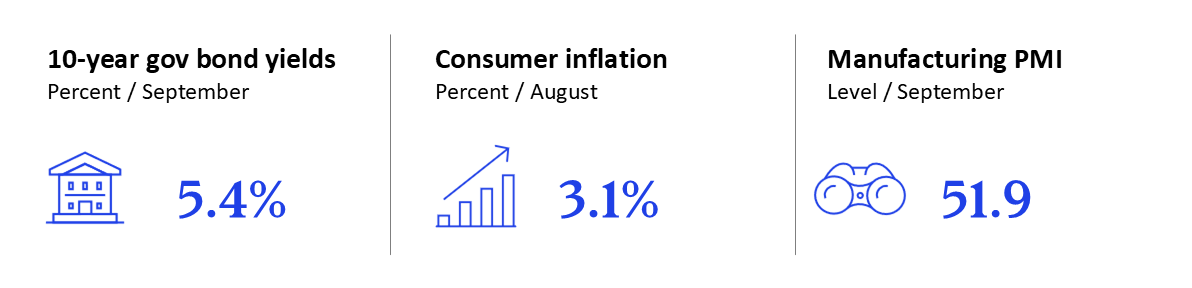
Activity proves more resilient than expected, but energy shock pushes inflation back up, contributing to sharp rise in borrowing costs; Bank of England (BoE) holds rates ahead of fiscally constrained October Budget. Monthly real GDP rose 0.4% in July, beating forecasts of no growth, with the three-month measure also up 0.4%—driven by services (+0.6%); production and construction each fell 0.5%. Business surveys point to softer momentum in September: the flash composite purchasing managers’ index (PMI) fell to a three-month low of 51.7 from August’s 52.5 as services growth slowed; the manufacturing PMI improved to 52.0. Household spending held up over the summer: retail sales volumes rebounded 0.5% in August, recovering July’s dip and reaching their second-highest level since April 2022. Higher-frequency indicators were softer, though: footfall and Revolut card spending both slipped on the month (−2% and −1%), though both were above year-ago readings. The GfK Consumer Confidence Index rose one point to −13 in September, still subdued, but a two-year high. The labor market continues to loosen. Unemployment held at 4.9% in the three months to July, while payrolled employment extended its decline: the provisional August estimate fell 26,000 and was 145,000 (0.5%) lower than a year earlier. Vacancies fell to 702,000, their lowest (outside the pandemic) since 2014. Regular pay growth held at 3.5% (2.9% in the private sector; 0.6% in real terms), pointing to limited second-round wage pressure so far. Inflation reaccelerated. The Consumer Price Index (CPI) rose to 3.1% in August, a five-month high and a second straight monthly increase. Transport led the rise, with motor fuel prices up 23% year on year and goods inflation at 2.7%. With core CPI unchanged at 2.6% and services steady at 3.4%, the pickup so far looks concentrated in energy rather than being broad-based. Near-term pressures are likely to remain elevated: Ofgem raises the price cap 4% in October and the Middle East conflict has kept energy prices high. |
|||||||||
|
|
|||||||||
|
|||||||||
|
|
|||||||||
|
Financial conditions tightened markedly. The 10-year gilt yield touched a 19-year high of about 5.4% in mid-September as oil topped $100, and the 30-year approached 6%, the highest since 1998. Higher market funding costs also fed through to households: the BoE’s quoted rate on a two-year fixed 75% loan-to-value (LTV) mortgage reached 4.92% in August, 99 basis points above its January level of 3.93%; mortgage approvals in July fell to 56,053—the lowest since early 2024. House-price growth remained subdued and indicators diverged: Lloyds reported a 0.4% annual decline in August—the first since November 2023—while Nationwide still recorded 1.6% year-on-year growth.
Against this backdrop, the BoE held the Bank Rate at 3.75% in September, again by 6–3, with three Monetary Policy Committee (MPC) members favoring a quarter-point hike. It judged inflation risks to have shifted further to the upside; Bank staff now expect inflation to reach slightly above 4% in early 2027. The MPC also unanimously slowed its balance-sheet rundown to about £46 billion a year—roughly half the recent pace—to limit risks to market functioning, while the Bank paused gilt-sale auctions as it reconsidered the implementation mechanism. Fiscal conditions remain constrained. August borrowing of £18.3 billion overshot the Office of Budget Responsibility’s (OBR) forecast by £3.5 billion and was £2.9 billion higher than a year earlier, as spending growth outpaced receipts. Financial-year-to-August borrowing stood at £77.3 billion—£8.1 billion above the OBR profile even though it was £2.2 billion lower than a year earlier—with net debt just below £3 trillion (93.8% of GDP). Attention turns to Chancellor John Healey’s first Budget on October 28, also the Burnham government’s first. The government has committed to the inherited fiscal rules and to not raising the main rates of income tax, employee National Insurance, or VAT. At the same time, borrowing is running above forecast and the government is pursuing an agenda of devolution and cost-of-living relief. |
|||||||||
|
|
|||||||||
|
|
|||||||||
|
Retail sales growth in China slowed to 0.4%; India’s central bank raises GDP growth projection to 6.7%; Brazil’s central bank makes 25 basis point rate cut.
China
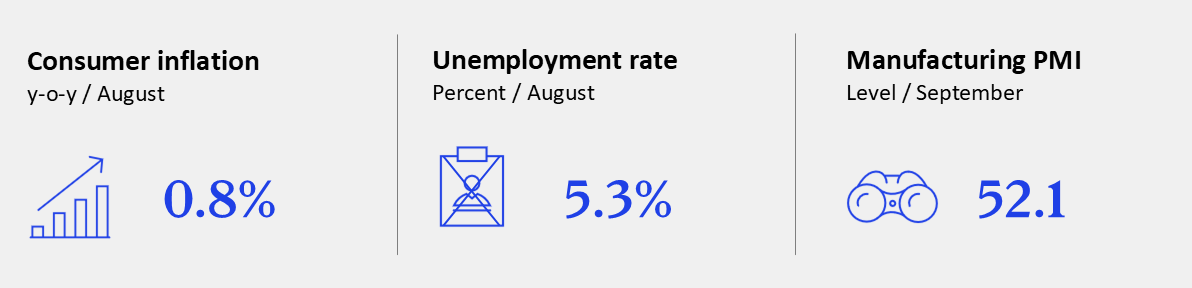
Manufacturing edged back into expansion in September, but weak domestic demand continued to weigh on sentiment; retail sales growth slowed to 0.4%, prompting targeted policy support rather than broad monetary easing. Industrial activity strengthened, with output growth accelerating to 5.3% in August from 4.6%, supported by high-tech and AI-related manufacturing. However, growth remains below year-ago levels, with third-quarter GDP growth estimated at 4.4%, down from 4.8% a year earlier. The manufacturing purchasing managers’ index (PMI) edged back into expansion at 50.1 in September, suggesting some stabilization in factory activity. However, the recovery remains uneven, with stronger performance in policy-supported industries yet to translate into broader economic momentum. Price pressures remain uneven. Producer prices rebounded to 3.8% in August from –2.9% a year earlier, driven partly by higher energy and commodity costs. Yet consumer inflation has stayed subdued at 0.8%, with the core consumer price index (CPI) at 1%, highlighting limited household pricing power. The widening gap between producer and consumer prices suggests that stronger industrial activity has yet to translate into sustained domestic demand, which remains the economy’s main weakness. Limited pricing power at the consumer level also points to continued pressure on businesses serving the domestic market. Household consumption remains subdued. Retail sales growth slowed to 0.4% as the impact of earlier subsidies faded and households continued prioritizing savings over spending. Consumer confidence continues to be depressed at 90, while unemployment rose to 5.3%, with rising youth joblessness adding further pressure. Housing showed tentative stabilization, with the annual decline in new-home prices having narrowed for four consecutive months. Nevertheless, falling property values continue to weigh on household wealth and spending decisions, limiting the potential for a stronger consumption-led recovery. |
|||||||||
|
|
|||||||||
|
|||||||||
|
|
|||||||||
|
Financial markets reflect persistent caution. The SSE Composite fell 3.6% in September, reversing much of the previous month’s gains. Beijing targeted mortgage-interest subsidies and cheaper policy-bank funding, leaving the one-year loan prime rate unchanged at 3%. The measures signal a preference for addressing property sector vulnerabilities without resorting to broad monetary stimulus. However, subdued market sentiment suggests investors remain cautious about the effectiveness of targeted measures in reviving domestic demand.
External demand remains a key growth engine. China’s trade surplus widened to $112.8 billion in August, supported by strong high-tech-related exports, which continue to offset weakness in domestic consumption. However, renminbi appreciation could increasingly pressure exporters’ margins and competitiveness, particularly in more price-sensitive industries. |
|||||||||
|
|
|||||||||
|
|
|||||||||
|
India
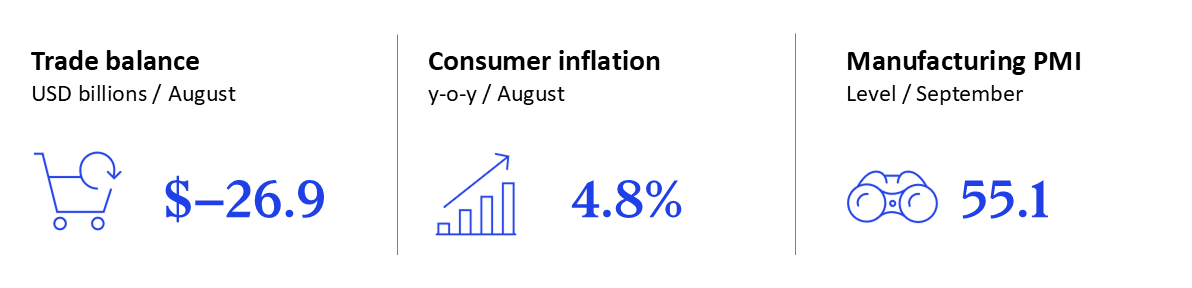
Central bank raises GDP growth projection to 6.7%, holds interest rates; composite PMI climbs. At its August 5 review, the Reserve Bank of India (RBI) raised its 2026–27 real GDP growth projection modestly to 6.7% (from 6.6% in June), reflecting the country’s economic resilience in the face of global uncertainties. The HSBC India Composite PMI rose to a three-month high of 55.9 in September from 54.3 in August, though the quarterly average was the weakest since early 2022. Manufacturing climbed to 55.1 from 52.8, its strongest in seven months, as new orders grew at their fastest pace in seven months. Services rose to 55.2 from 54.1, the best reading since June. Domestic demand drove the gain while export orders slowed, and cost inflation eased to its lowest level since November 2025. The Index of Core Industries (ICI) grew 4.8% year on year in August 2026, down from 5.0% in July 2026, led by cement (+12.5%), electricity (+11.6%), iron ore (+5.5%), steel (+3.4%), and refinery products (+2.6%); coal, natural gas, crude oil, and fertilisers contracted. Iron ore, electricity, and cement have been the main drivers of ICI growth over recent months. |
|||||||||
|
|
|||||||||
|
|||||||||
|
|
|||||||||
|
Retail inflation (CPI) stood at 4.82% in August, with food inflation (CFPI) firming to 5.95% from 5.52% in July as weak monsoon rains lifted staple prices. Price pressures were also close to or above 4% in clothing, household goods, and education, while food-serving services inflation rose to 8.41% from 7.75%. Rises were concentrated in items such as silver jewellery (107.11%), ginger (73.82%), onions (48.27%), garlic (43.60%), and gold/diamond/platinum jewellery (35.53%). Core inflation (CPI excluding food and fuel) rose to 4.2% in August from 3.86% in July, pointing to firmer underlying demand pressure. Equity markets fell 3.37%, with the SENSEX down to 74,858.99 on September 21 from 77,472.94 on August 26, as crude climbed sharply. The Indian crude basket averaged $109.76 a barrel on September 15, amid a resurgent Iran-US conflict, while Brent futures eased 0.78% to $103.06 on September 21.
The rupee firmed to 95.79 on September 21 from 95.92 on September 15. Forex reserves fell by $4.92 billion to $780.78 billion in the week to September 11, led by lower foreign-currency assets and gold, following a record single-week jump of $44.90 billion to an all-time high of $785.70 billion in the week to September 4. The RBI’s MPC voted unanimously to keep the policy repo rate at 5.25% (SDF 5.00%, MSF and Bank Rate 5.50%) and retained its neutral stance, favouring a wait-and-watch approach. Merchandise exports rose more than 26% year on year to $43.81 billion in August 2026 from $34.74 billion and outpacing imports, which grew to $70.67 billion from $61.96 billion, narrowing the trade deficit. The previous month, India’s current account deficit had widened to $7.0 billion, from $3.2 billion in July 2025, driven primarily by a wider merchandise trade deficit. India and New Zealand will bring their Free Trade Agreement into force from October 20, giving fresh momentum to bilateral trade, technology, and investment ties, with zero duty on 100% of India’s exports to New Zealand from day one and duty-free access for textiles, leather, footwear, engineering goods, and agri-processing—creating new opportunities for India’s youth, women, farmers and micro-, small, and medium-size enterprises through jobs, investment, and mobility. Meanwhile, India and MERCOSUR signed the First Additional Protocol to their Preferential Trade Agreement to facilitate electronic Certificates of Origin, advancing paperless trade and modernising customs procedures. |
|||||||||
|
|
|||||||||
|
|
|||||||||
|
Brazil
Brazil’s inflation and unemployment both tilted down; central bank makes 25 basis point rate cut. In a unanimous decision on September 16, Banco Central do Brazil’s Monetary Policy Committee (Copom) decided to cut the Selic rate by 25 basis points, bringing it to 13.75%. Copom noted that the decision is compatible with a strategy focused on converging inflation to the planned target, while also seeking to smooth economic fluctuations and foster full employment. However, various factors, including the conflict in the Middle East, are noted as reasons to be cautious for emerging economies such as Brazil, alongside fiscal and other local risks. Inflation was down in August, touching 4.22% (4.44% in July), below the central bank’s upper target limit of 4.50%. Amid ongoing Middle East tensions, Brazil’s government increased gasoline subsidies to 43%, bringing total aid to BRL 0.63 per liter. Meanwhile a BRL 1.00 subsidy on diesel was also introduced. The measures are expected to cost BRL 6.6 billion and are projected to be offset by extraordinary oil windfall revenues and extraordinary credits. An ethanol tax reduction of BRL 0.19 effectively brings levies on biofuel to zero. The three-month moving average unemployment rate edged down to 5.3% in July from June’s 5.4%. On the financial markets, the average monthly real–dollar exchange rate was BRL 5.16 per USD in August (versus BRL 5.11 in July). The Bovespa equities index was stable in August; however, performance has recently been improving, with the index up 4.5% as of September 18. |
|||||||||
|
|
|||||||||
|
|||||||||
|
|
|||||||||
|
Consumer confidence stayed below the neutral 100 mark, with FGV’s seasonally adjusted August reading moving down to 84.7. Meanwhile, business confidence declined to 91.1. Construction confidence deteriorated to 92.1.
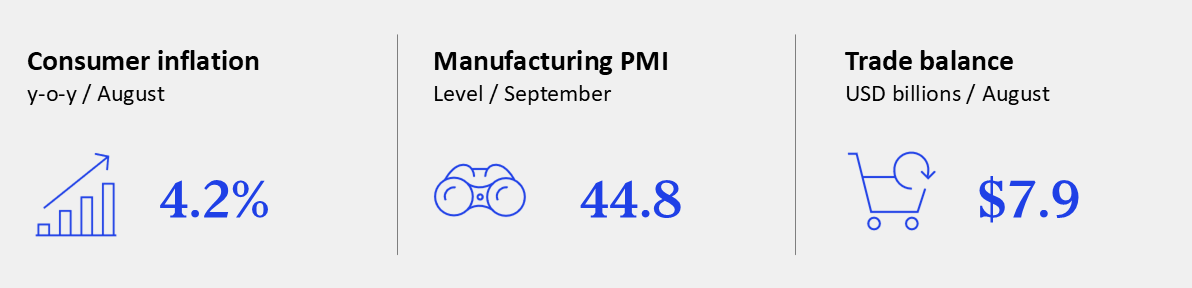
Monthly manufacturing production increased: the Monthly Industrial Physical Production (PIM) Index rose from 105.5 in June to 111.7 in July (still above the neutral 100 line). Factory production increased 6.6%, while extractive production was up 1.6% in comparison with the previous month. On aggregate, however, July 2026’s results were 0.5% below those from the same month last year. The Monthly Services Survey (PMS) revenue index increased to 135.7 in July from 132.6 in June (above the neutral 100 mark). This was mirrored in the volume index, which rose to 110.8 (from 109.0). The largest revenue increase was other family services (up 4.7% since June), followed by air transportation services (up 1.8%). Meanwhile, non–real estate rent volumes were up 3.2%, while the other family services segment rose 2%. August’s trade balance recorded a surplus of $7.9 billion, up from $6.5 billion in July. The larger surplus was the result of a decrease in imports ($25.7 billion in August, down from $27.1 billion in July) and a smaller decrease in exports ($33.1 billion in August, down from $33.7 billion in July). Brazil’s presidential election on October 4 saw Flávio Bolsonaro (eldest son of jailed former president Jair Bolsonaro) lead with 47.03% of the vote; incumbent “Lula” received 45.16%. The “blue wave” has reshaped the Senate, with 30 of the 54 senators aligned to Bolsonaro; in the gubernatorial race, currently 11 of 20 of those elected during the first round are Bolsonaro supporters. Brazilians return to the polls for run-off elections on October 25. |
|||||||||
|
|
|||||||||
|
|
|||||||||
|
Russia
Second-quarter recovery confirmed by GDP reading with growth impulse likely to fade over coming months; subdued activity over summer; inflation accelerated; ruling party won parliamentary election.
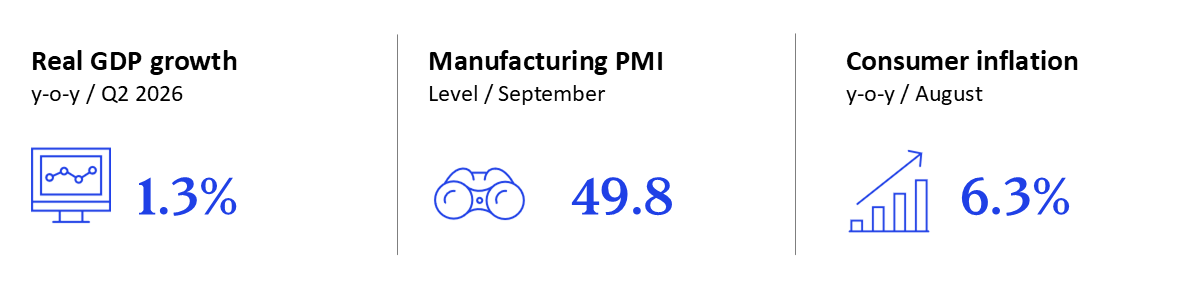
The second GDP reading confirms that the Russian economy grew by 1.3% year on year in the second quarter of 2026. Given contraction in activity in quarter one that created a low base, this marks a strong rebound of 0.9% quarterly and the strongest growth in the last six quarters. That said, overall GDP growth in the first half of 2026 was just 0.6% on a yearly basis. Preliminary figures indicate that most of quarter two’s annual growth was driven by retail sales and services, while production in extractive industries and construction declined by nearly 2%. The better-than-expected GDP figure was likely driven by a strong fiscal outlay: government spending jumped at the end of the first quarter and, during the second quarter, has remained 16% up on last year. This likely underpinned some improvement in fixed investment. Private consumption also performed relatively well in the first half, with wages growth still above inflation and improving credit activity. Some of the growth impulse is likely to fade in the second half of the year, with full-year growth expected at between 0 and 1%. Private spending will be squeezed by rising inflation and high borrowing costs. Imports of refined fuels are rising, while the discount on Russian Urals crude to the Brent benchmark is growing wider again, hurting net exports. Government spending is also easing. Economic activity in June remained subdued, with industrial production essentially unchanged from previous months. For the first seven months of this year, mining output contracted by 1% versus last year, while manufacturing grew by 0.5%. Manufacturing was largely supported by industries linked to the war, and output continued to contract in most other industries. |
|||||||||
|
|
|||||||||
|
|||||||||
|
|
|||||||||
|
Consumer price inflation accelerated further in August, with prices up by 6.3% annually amid continued supply chain disruptions and increasing fuel prices. Rapid growth in government expenditure also contributed to supply-demand imbalance and fueled inflation.
On September 18–20 Russia held its first parliamentary elections since the full-scale invasion of Ukraine. The incumbent United Russia party won 58% of the vote, translating into 355 seats in the 450-seat Duma—around 20 more seats than it currently holds and marking the strongest result in its history. Only parties that support the current regime were registered to run and the opposition was barred from taking part. The vote was also the first to include residents of four regions in Ukraine (Donetsk, Luhansk, Kherson, and Zaporizhzhia) that were occupied and illegally annexed by Moscow. The Kremlin is likely to use the result to claim that most Russians have rallied behind the president, and to justify future policies and subsequent decisions on the course of the war. |
|||||||||
|
|
|||||||||
|
|
|||||||||
|
Mexico
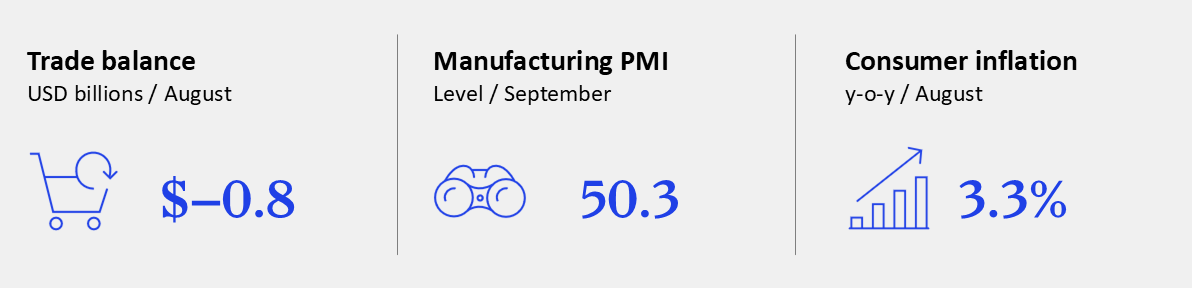
Mexico’s economic momentum remained moderate, supported by contained inflation and stronger formal employment, despite softer manufacturing activity and deteriorating trade. Macroeconomic conditions changed only modestly in August, with inflation remaining contained and monetary policy unchanged. Annual inflation increased to 3.3% from 3.1% in July but remained within the Bank of Mexico’s target range. The central bank kept its policy rate unchanged at 6.5%, while the peso strengthened to an average of MXN 17.1 per USD from MXN 17.5 per USD in July. Manufacturing activity weakened in August, with the Purchasing Managers’ Index (PMI) falling to 49.8 from 51.3 in July as output contracted more sharply, new-order growth slowed, and new export orders declined at their fastest pace of the year. Material shortages and shipping disruptions, including those linked to the Middle East conflict, also weighed on production. Formal employment improved in August, with 38,319 positions added, bringing the total to 22.8 million, the second-highest level recorded this year. Permanent positions accounted for 87.1% of total employment and reached 19.9 million. Sectoral gains were led by transportation and communications, with annual employment growth of 6.6%, followed by extractive industries at 4.7% and social and community services at 3.7%. The unemployment rate remained unchanged at 2.7% in August from the previous month. |
|||||||||
|
|
|||||||||
|
|||||||||
|
|
|||||||||
|
External accounts weakened in July, with the trade balance shifting to a $0.8 billion deficit from a $4.1 billion surplus in June. Exports increased 12.2% month on month to $81.4 billion from $72.5 billion, supported by stronger manufacturing shipments, while imports rose 20.2% to $82.3 billion from $68.5 billion. The increase in exports was particularly strong in electrical and electronic equipment, machinery, and other non-automotive manufacturing categories. Meanwhile, the surge in imports was driven largely by intermediate goods, which rose 18.8% month on month, reflecting higher purchases of non-oil production inputs; capital-goods imports also increased 7.3%, while consumer-goods imports declined 1.4%.
Since the July review of the United States-Mexico-Canada Agreement (USMCA), negotiations have continued without a comprehensive agreement. Discussions have covered automobiles, steel and aluminum, economic security, labor, agriculture, electronic payments, and the role of non-USMCA countries in regional supply chains. Mexico has continued to emphasize that the agreement remains in force and that preserving preferential access to the US market is a priority. The Mexican government has focused on securing lower tariffs on vehicles, steel, and aluminum, while also seeking greater predictability during the review process. At the same time, Mexico has engaged with US concerns over rules of origin, regional manufacturing, and “free-riding” by non-parties, including through efforts to strengthen North American supply chains and reduce reliance on selected imports from Asia. In mid-September, President Claudia Sheinbaum said bilateral discussions were progressing and that some understandings had been reached, although no final agreement had yet been announced. |
|||||||||
|
|
|||||||||
|
|||||||||
|
|
|||||||||
|
|||||||||
|
McKinsey’s Global Economics Intelligence (GEI) provides macroeconomic data and analysis of the world economy. Each monthly release includes an executive summary on global critical trends and risks, as well as focused insights on the latest national and regional developments. Detailed visualized data for the global economy, with focused reports on selected individual economies, are also provided as PDF downloads on McKinsey.com. The reports available free to email subscribers and through the
McKinsey Insights App. To add a name to our subscriber list,
click here. GEI is a joint project of
McKinsey’s Strategy and Corporate Finance Practice and the
McKinsey Global Institute.
Shubham Singhal is the Chair of McKinsey's Global Institute and a senior partner in the Detroit office; Arvind Govindarajan is a partner in the Boston office. The data and analysis in McKinsey’s Global Economics Intelligence are developed by Jeffrey Condon, a senior expert in McKinsey’s Atlanta office; Krzysztof Kwiatkowski is an expert in the Boston office. The authors wish to thank Nick de Cent, as well as Masud Ally, José Álvares, Roman Büschgens, Sofía Córdoba, Gabriel Marini, Tomasz Mataczynski, Frances Matamoros, Alejandro Morales, Beatriz Oliveira, Debdoot Ray, Nikita S, Vanshika Tandon, and Valeria Valverde for their contributions to this article. |
|||||||||
|
|||||||||
|
The invasion of Ukraine continues to have deep human, as well as social and economic, impact across countries and sectors. The implications of the invasion are rapidly evolving and are inherently uncertain. As a result, this document, and the data and analysis it sets out, should be treated as a best-efforts perspective at a specific point of time, which seeks to help inform discussion and decisions taken by leaders of relevant organizations. The document does not set out economic or geopolitical forecasts and should not be treated as doing so. It also does not provide legal analysis, including but not limited to legal advice on sanctions or export control issues.
|
|||||||||
|
|
|||||||||
|